TheatreScene.net
The NAI-NI CHEN DANCE COMPANY offers six works combining an Asian sensibility with western modern dance styles danced by eight terrific, talented performers.
NAI-NI CHEN DANCE COMPANY
at the Ailey Citigroup Theater
by
Joel Benjamin
Nai-Ni Chen, a Taiwan native, brought her attractive company to the Ailey Citigroup Theater for two performances on May 23rd & 24th (at 8 p.m.). She showed six works all inspired by events, sites and legends of her native China.
"Raindrops" for four women dressed in pale, long, tunics over brighter-colored pants, was an homage to her hometown, Keelong, known as Rain Harbor. To the sounds of bells and bongs the four dancers--Julie Fiorenza, Chu-Ying Ku, Teri Miller & Lindsay Parker--rose out of a group pose into little worlds of their own in different sections of the stage. They came together in pairs and threes, skittering and lunging and finally, carrying lovely parasols, playfully interacted in elegant, picturesque ways. They ended in a tight group, posing quietly. "Raindrops" had an almost picture postcard feel, tempered by the light sensuality of the free-flowing modern dance steps.
"Incense," danced by Ms. Firorenza, Ms. Miller and two men, Noibis Licea & Qiao Zeng, has meant to recall the lightness of a rising incense haze, but came ac=oss as much heavier in tone. The dancers, all in white, the men barechested, kept grouping and regrouping, swooping about the stage using un=ulating gestures and some light lifts. Sometimes three dancers danced against a faster moving soloist and sometimes they formed two couples but most often they danced alone, coming together in a sculptural pole in which three dancers crouched together while one hovered above them, raised arms lightly moving as in a benediction. The incense imagery simply didn't come across, not helped by a score by Joan La Barbara which featured humming over harsher, machinelike sounds.
"On the River of Dreams" showed the closest thing to an emotional relationship in the entire program. To a boinging score of percussion and strings by Forr=st Fang, Lindsey Parker and Ziao Zeng portrayed a ferryman and his fare who= according to the Ms. Chen's program note, was the "spirit of the water."&n=sp; Mr. Zeng, barechested, in loose black pants, hoisted a long bamboo pole pulling Ms. Parker, in rose & gray along with him. (Costumes by Karen Young.) Using swift, flatfooted steps, they travelled about the stage, often entwining. The ferryman's pole was used to lift his passenger and became, in turn, a bridge over the water, his oar and a symbol of high connection to his spirit. She leapt at him and hung off the pole, movements interrupted by more peaceful periods of movements
tranversing the stage. Ms. Chin created a lovely picture here with just the hint of sexuality.
"The Way of Five, No. 2 - Fire" was a part of a longer work dealing with the five elements of Chinese mythology: wood, fire, water, metal and earth. Dressed in tights. Chen's bright red costumes and moving to a score of cello against drums by Tan Dun), the five dancers followed the pattern set by earlier work and kept coming together and then apart, with the lone man, Mr. Licea, lifting some of the women. The movements had a slightly sharper quality and the ending in which all fall into slides on their stomachs along a good portion of the playing was exciting.
"The Way of Fire, No. 3 - Water" opened the second half of the program. The six dancers wore lovely, translucent white robes designed by Anna-Alisa Belou and danced to a multi-dimensional and subtle percussion score commissioned from Gerald Chenoweth. The featured movement motif here was softly treading whirling, perhaps to indicate the water theme. Again, the dancers worked in groups against each other and combined undulating upper body movements with curlicue arm gestures and, again, the work ended in a sculptural pose with one lovely dancer on top gesturing out to the audience.
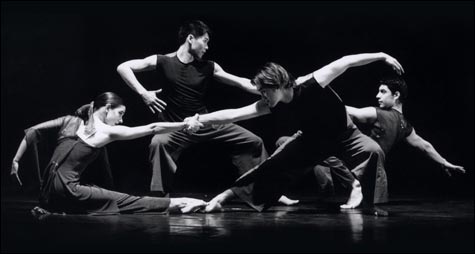
The final work was, by far, the most interesting movement-wise. "Unfolding" was ori=inally performed out of doors at Wave Hill in the Bronx and this expansiveness showed even on the smallish stage of the Ailey Center. The three men (now including Wei Yao), barechested and in dark pants were discovered curled up on the stage as the four women in layered, diagonally patterned costumes in red, gold and blue entered and variously touched and rearranged them. The men variously carried and lifted the women and moved amongst them creating many combinations of partners. This was the first work to have large jumps and some movements that resembled martial arts jabs and falls. The music by Harry Lee featured voices humming and shouting above percussive sounds and it created a lively environment in which the dancers related combatively in almost a battle of the se=es in which both sexes pretty much moved the same way. "Unfolding" built to a solid climax of jumps.
NAI-NI CHEN DANCE COMPANY has eight terrific dancers who are completely immersed in Ms. Chen's style of movement which combines a kind of Martha Graham-lite with Asian gestures and philosophy. They are all beautiful to look at and very much involved in whatever they are asked to do.
However, Ms. Chen needs to introduce some humor into her work. The works were almost too beautiful, lacking any deep emotion and sexuality. Mind you, the ballets weren't dreary or even too dark, just too meditative with say too many slow motion movements, as if the dancers were moving through water. The moods of these six works were made to seem different through the brilliant lighting Susan Summers and A.C. Hickox. Ms. Chen's over-achieving program notes didn't help, either. She clearly wanted u= to understand what inspired her to choreograph each piece, but fewer words and clearer choreography would paint the pictures better. Each of the program notes could have been reduced to ten words and have a stronger effort, letting the audience decide what each work meant.
In the end, the NAI-NI CHEN DANCE COMPANY displayed an original artist=c vision, fine performances by eight beautifully trained dancers, great cos=umes and lighting and a yearning for depth not quite found. The works were never uninteresting to the eye, but more variation would have spiced up the show.
NAI-NI CHEN DANCE COMPANY
Nai-Ni Chen, Artistic Director and Choreographer
Dancers: Selena Chau, Julie Fiorenza, Chu-Ying Ku, Noibis Licea, Teri Miller, Lindsey Parker, Wei Yao & Qiao Zeng
at the Ailey Citigroup Theater
405 West 55th St.
New York, NY 10019


.jpg)





 Posts
Posts


